
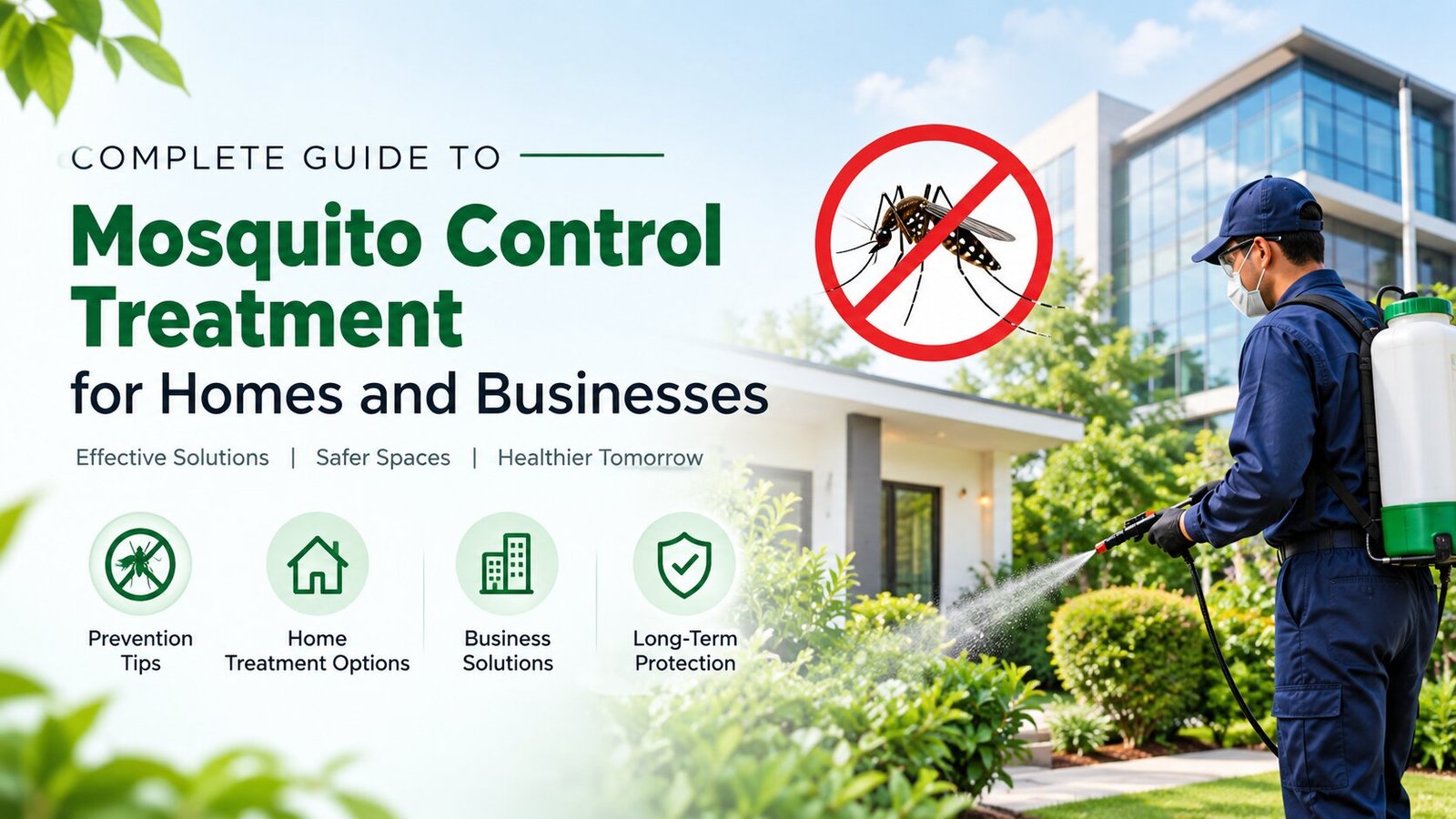
Complete Guide to Mosquito Control Treatment for Homes and Businesses
Mosquitoes are more than a seasonal nuisance. A small mosquito problem can quickly become a persistent infestation when standing water, humid conditions, and suitable breeding areas are available. For homes, offices, restaurants, schools, warehouses, and commercial properties, effective mosquito management requires more than simply killing the mosquitoes that are visible.
A successful mosquito control treatment combines source reduction, targeted treatment, prevention, and regular monitoring. This approach helps reduce mosquito populations and makes the property less attractive for future breeding.
In this complete guide, we explain how mosquito control works, common mosquito breeding areas, professional treatment methods, prevention tips, and when it makes sense to hire a professional pest control service.
What Is Mosquito Control Treatment?
Mosquito control treatment is a combination of methods used to reduce mosquito populations around a property and prevent them from returning.
Depending on the property and level of infestation, treatment may include:
- Identifying mosquito breeding areas
- Removing or managing stagnant water
- Treating mosquito larvae in suitable breeding sites
- Applying targeted adult mosquito control treatments
- Treating vegetation and outdoor resting areas where appropriate
- Recommending environmental modifications
- Monitoring mosquito activity
- Scheduling follow-up treatments when necessary
The goal isn’t simply to kill adult mosquitoes. Effective mosquito management focuses on breaking the mosquito life cycle.
Why Is Mosquito Control Important?
Mosquitoes can interfere with everyday life and create health concerns because some mosquito species can transmit diseases.
The World Health Organization notes that mosquitoes can transmit diseases including dengue, malaria, chikungunya, yellow fever, Japanese encephalitis, and others, depending on the mosquito species and geographic area.
This makes mosquito prevention particularly important in areas where mosquito-borne diseases occur.
For businesses, mosquitoes can also create an uncomfortable environment for:
- Employees
- Customers
- Guests
- Students
- Visitors
- Outdoor event attendees
A proactive mosquito control service can therefore be an important part of maintaining a comfortable and well-managed property.
Common Mosquito Breeding Areas Around Homes and Businesses
Mosquitoes require water to complete their life cycle. Even relatively small amounts of standing water can become breeding sites for certain species.
Common areas include:
1. Water Storage Containers
Buckets, drums, tanks, and uncovered containers can collect or hold water.
Keep water-storage containers properly covered and inspect them regularly.
2. Plant Pots and Trays
Water can accumulate in plant saucers and decorative containers.
Empty unnecessary water regularly and keep containers from becoming long-term sources of stagnant water.
3. Roof Gutters
Blocked gutters can retain rainwater and create suitable mosquito breeding conditions.
Regular gutter cleaning can help reduce this risk.
4. Drainage Areas
Poor drainage around buildings can result in standing water after rainfall.
Improving drainage can be an important part of long-term mosquito management.
5. Ponds and Water Features
Decorative ponds, fountains, and other water features can become breeding areas if they are not properly maintained.
6. Construction Sites
Construction properties can have numerous temporary water-holding containers, equipment, pits, and other areas where rainwater collects.
Regular inspections are particularly important on these sites.
7. Outdoor Equipment and Waste
Discarded containers, old tires, plastic items, and other objects can collect rainwater.
Removing unnecessary water-holding objects is one of the simplest mosquito prevention measures.
How Does Professional Mosquito Control Treatment Work?
A professional treatment normally begins with an inspection.
Step 1: Property Inspection
A pest control professional assesses the property for:
- Mosquito activity
- Breeding sites
- Standing water
- Vegetation
- Drainage problems
- Outdoor resting areas
- Potential entry points
- Conditions that encourage mosquito activity
The inspection helps determine which control measures are appropriate.
Step 2: Source Reduction
Where practical, standing water is removed or managed.
This could involve:
- Emptying containers
- Cleaning gutters
- Improving drainage
- Covering water-storage containers
- Removing discarded objects
- Maintaining water features
Source reduction is an important component because it addresses where mosquitoes reproduce.
Step 3: Larval Mosquito Control
In certain situations, professionals may use products designed to control mosquito larvae in appropriate water sources.
The specific product and application method should depend on the location, water type, mosquito species, and applicable regulations.
Step 4: Adult Mosquito Control
Professionals may also use targeted treatments to reduce adult mosquitoes in areas where they rest.
Depending on the situation, treatment may focus on suitable outdoor vegetation, shaded areas, and other mosquito resting locations.
Step 5: Follow-Up and Prevention
Mosquito management works best as an ongoing process.
A professional may recommend follow-up inspections or treatments based on:
- Mosquito activity
- Weather conditions
- Property characteristics
- Presence of breeding sites
- Local mosquito pressure
Mosquito Control Treatment Methods
Different properties require different approaches.
Chemical Mosquito Treatment
Professionals may use approved insecticides to control adult mosquitoes or mosquito larvae.
Applications should always follow the product label and applicable local requirements.
The treatment area should be selected carefully to avoid unnecessary exposure to people, pets, wildlife, and beneficial insects.
Larval Control
Larval control targets mosquitoes before they become adults.
It can be particularly useful in suitable water-holding areas that cannot reasonably be eliminated.
Biological Control
Some mosquito-management programs use biological approaches, such as products containing Bacillus thuringiensis israelensis (Bti), which targets mosquito larvae in appropriate environments.
Physical Prevention
Physical measures are often among the most important long-term controls.
Examples include:
- Removing standing water
- Covering containers
- Installing or repairing screens
- Improving drainage
- Maintaining gutters
- Eliminating unnecessary water-holding items
Integrated Mosquito Management
The most comprehensive approach combines several methods rather than relying on one treatment alone.
This is often referred to as Integrated Mosquito Management (IMM).
DIY Mosquito Control vs. Professional Treatment
Homeowners can take several useful steps themselves, but persistent mosquito problems may require professional assistance.
| DIY Mosquito Prevention | Professional Mosquito Control |
|---|---|
| Remove standing water | Property inspection |
| Clean containers | Identify breeding and resting areas |
| Maintain gutters | Targeted professional treatment |
| Use window screens | Larval control where appropriate |
| Improve drainage | Ongoing monitoring |
| Use personal mosquito protection | Customized management plan |
DIY prevention is particularly useful for eliminating breeding conditions.
Professional treatment can be helpful when mosquito activity remains high despite basic preventive measures or when the property is large or difficult to manage.
How to Prevent Mosquitoes Around Your Home
You don’t have to wait until mosquitoes become a major problem.
Remove Standing Water
Inspect your property regularly for water collected in:
- Buckets
- Pots
- Tires
- Containers
- Gutters
- Toys
- Tarps
- Outdoor equipment
Keep Water Containers Covered
Water-storage containers should be appropriately covered to prevent mosquitoes from accessing the water.
Maintain Your Garden
Overgrown vegetation and shaded areas can provide resting locations for adult mosquitoes.
Regular garden maintenance can help reduce favorable conditions.
Maintain Window and Door Screens
Repair damaged screens and ensure doors and windows close properly.
Improve Drainage
Areas that repeatedly hold water should be evaluated for drainage improvements.
Protect Yourself Outdoors
When mosquitoes are active, use appropriate personal protection such as long sleeves, long trousers, and mosquito repellents according to their label directions.
Mosquito Control for Businesses
Commercial properties can have more complex mosquito-control challenges than residential properties.
Restaurants, hotels, schools, offices, hospitals, factories, warehouses, apartment complexes, and outdoor venues may have larger areas and multiple potential breeding sites.
A commercial mosquito control treatment program may include:
- Routine inspections
- Standing-water management
- Landscape assessment
- Targeted treatment
- Monitoring
- Documentation
- Preventive recommendations
- Scheduled follow-up visits
For businesses with outdoor customer areas, mosquito management can also contribute to a more comfortable environment for visitors.
Mosquito Control for Restaurants and Outdoor Dining Areas
Restaurants with gardens, terraces, balconies, or outdoor seating may experience mosquito activity around landscaped areas and water-holding objects.
Management should focus on:
- Identifying standing water.
- Inspecting plant containers and drainage areas.
- Maintaining landscaping.
- Checking gutters and drains.
- Managing water features.
- Using appropriate professional treatments when necessary.
Food businesses should also ensure that any pest-control application complies with applicable food-safety requirements and product-label restrictions.
Mosquito Control for Apartments and Housing Societies
Apartment complexes can be challenging because mosquito breeding areas may exist across shared spaces.
Common problem areas include:
- Roofs
- Parking areas
- Gardens
- Drains
- Water-storage areas
- Construction zones
- Common landscaping
- Waste-management areas
A coordinated community-level approach can be more effective than individual residents treating only their own apartments.
How Often Should Mosquito Control Treatment Be Done?
There is no single treatment schedule that works for every property.
Treatment frequency can depend on:
- Local climate
- Rainfall
- Temperature
- Property size
- Mosquito species
- Standing-water conditions
- Landscaping
- Previous mosquito activity
- Seasonal changes
Properties experiencing persistent mosquito pressure may require regular monitoring and repeated treatments.
Instead of choosing a fixed schedule without an inspection, property owners should consider the actual conditions at the site and recommendations from a qualified pest-control professional.
When Should You Hire a Professional Mosquito Control Service?
Consider professional assistance when:
- Mosquito activity remains high despite removing standing water.
- Your property has multiple difficult-to-manage breeding areas.
- You manage a large commercial property.
- Customers or employees are regularly exposed to mosquitoes.
- You are dealing with recurring mosquito problems.
- You need a structured monitoring and treatment program.
- You are unsure where mosquitoes are breeding.
Professional pest-control technicians can identify conditions that may be easy to overlook during a basic property inspection.
How to Choose a Mosquito Control Company
Before hiring a mosquito control provider, consider asking:
Does the Company Inspect the Property?
A good treatment plan should be based on the actual conditions at the site.
What Treatment Methods do they Use?
Ask what products and techniques will be used and where they will be applied.
Do they Focus on Breeding-site Management?
Controlling standing water and breeding conditions is an important part of long-term mosquito management.
Are follow-up Services Available?
Recurring mosquito activity may require monitoring and additional treatment.
Does the Service follow Applicable Regulations?
Choose a provider that uses pest-control products according to their labels and applicable local requirements.
Common Mosquito Control Mistakes to Avoid
Ignoring Small Amounts of Standing Water
A small container can still become a mosquito breeding site.
Treating Only Adult Mosquitoes
Killing adult mosquitoes without addressing breeding conditions may provide only temporary relief.
Neglecting Gutters and Drains
Water retained in drainage systems can contribute to mosquito breeding.
Overusing Insecticides
More pesticide does not necessarily mean better mosquito control. Applications should be targeted and made according to product-label directions.
Forgetting Follow-Up Prevention
After treatment, new breeding sites can develop because of rainfall, irrigation, or changes around the property.
Final Thoughts
Effective mosquito control treatment is about more than spraying mosquitoes. A successful approach starts by understanding where mosquitoes breed, eliminating or managing standing water, reducing suitable resting areas, and using targeted control methods when necessary.
For homes, regular inspections and simple prevention measures can significantly reduce mosquito-friendly conditions. For businesses and larger properties, a professional mosquito management program can provide a more structured approach to monitoring, prevention, and treatment.
Whether you’re dealing with mosquitoes around a home, apartment complex, office, restaurant, school, or commercial property, the key is to control the source, manage mosquito populations, and prevent new breeding sites from developing.
UltraPest Solution is a leading provider of professional mosquito control treatment services in surat, helping homes and businesses manage mosquito infestations effectively. We also provide Mosquito control treatment services in vadodara , Mosquito control treatment services in vapi, Mosquito control treatment in bharuch, Mosquito control treatment in ankleshwar, Mosquito control treatment in valsad, Mosquito control treatment in Mumbai, Mosquito control treatment in silvassa, Mosquitoes pest control services in daman Also with professional solutions tailored to residential and commercial properties.
FAQs
1. What is Mosquito Control Treatment?
It is a professional method to reduce mosquitoes and control their breeding areas.
2. Why is Mosquito Control Important?
It helps reduce mosquito activity and creates a more comfortable environment.
3. How often Should Mosquito Treatment be Done?
Treatment frequency depends on mosquito activity, weather, and property conditions.
4. Can Mosquito Treatment Completely Eliminate Mosquitoes?
It can significantly reduce mosquito populations, but complete elimination is difficult.
5. What Attracts Mosquitoes?
Standing water, moisture, shade, and dense vegetation can attract mosquitoes.
6. Is Professional Mosquito Control Effective?
Yes. Professional treatment combines inspection, prevention, and targeted control methods.
7. Can I Prevent Mosquitoes Naturally?
Yes. Remove standing water, maintain drains, clean gutters, and keep water containers covered.
8. Is Mosquito Treatment Safe for Pets?
Safety depends on the treatment product. Always follow the provider’s safety instructions.
9. How Long Does Mosquito Treatment Last?
Results vary depending on weather, treatment type, and mosquito breeding conditions.
10. When should I Call a Mosquito Control Professional?
Contact a professional when mosquito activity remains high despite regular prevention.