
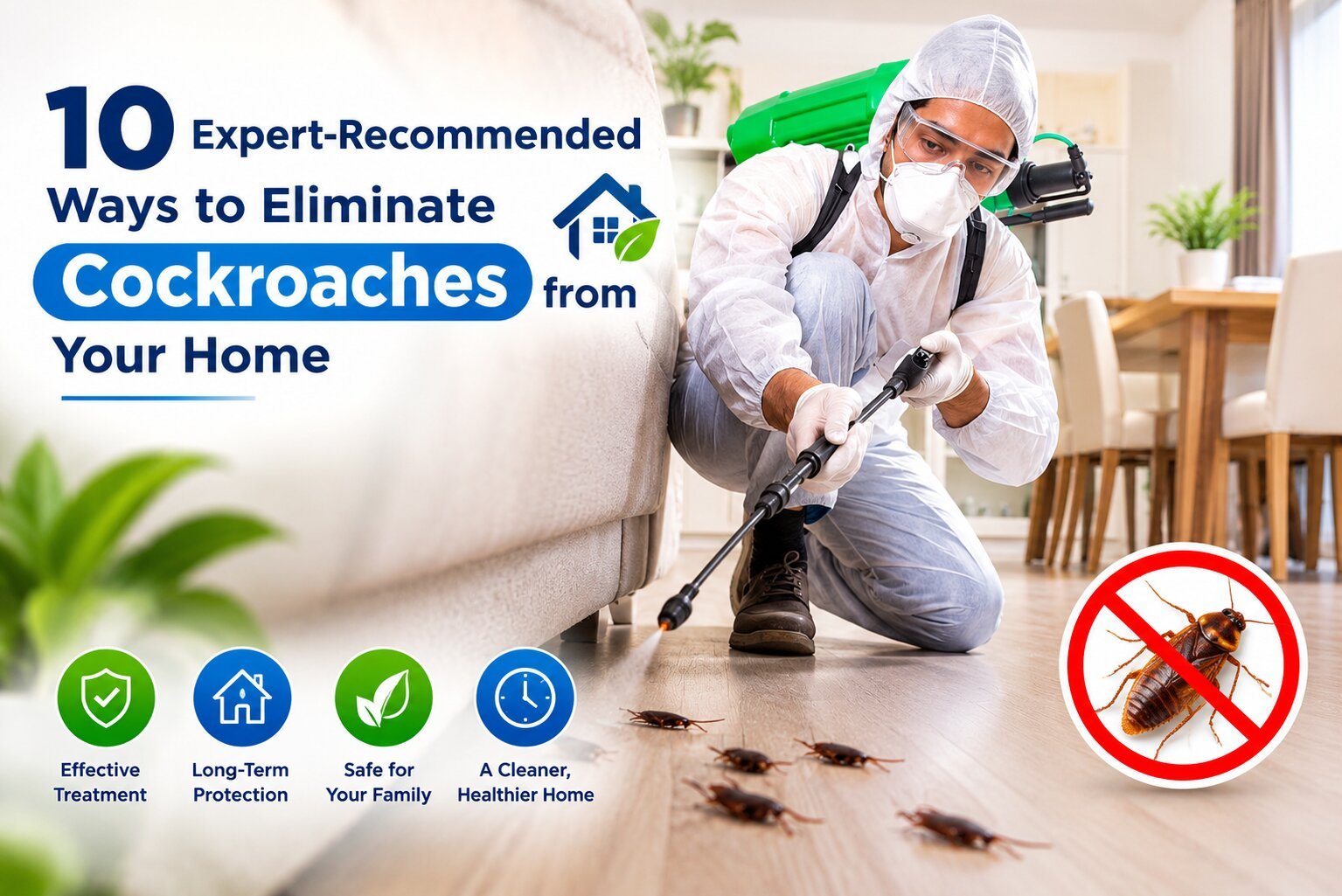
10 Expert-Recommended Ways to Eliminate Cockroaches from Your Home
Cockroaches are more than an unpleasant sight in your kitchen or bathroom. They can hide in cracks, cabinets, drains, wall voids, and other dark, warm, and moist areas, making them difficult to eliminate with occasional spraying.
A long-term solution requires more than killing the cockroaches you can see. Effective cockroach management focuses on removing food and water sources, reducing hiding places, blocking entry points, monitoring activity, and using appropriate treatments when necessary. This approach is commonly known as Integrated Pest Management (IPM).
If you are dealing with a recurring infestation, professional cockroach control treatment services in Surat can also help identify infestation hotspots and develop a targeted treatment plan.
Here are 10 expert-recommended ways to control cockroaches and make your home less attractive to them.
Why Do Cockroaches Enter Your Home?
Cockroaches generally look for three basic resources:
- Food
- Water
- Shelter
Kitchens, bathrooms, utility areas, drains, storage rooms, and other damp or cluttered areas can provide these conditions.
Cockroaches are primarily active at night and often hide during the day. Depending on the species, they may live indoors or enter buildings from outdoor areas, drains, sewers, cracks, and other sheltered locations.
This is why simply killing visible cockroaches may not solve the underlying problem.
1. Keep Your Kitchen Clean and Remove Food Sources
One of the most important steps in cockroach control is reducing access to food.
Even tiny food particles, grease, crumbs, and spilled liquids can provide an available food source.
Make kitchen cleaning part of your daily routine:
- Wipe countertops after preparing food.
- Clean spills as soon as they occur.
- Sweep or vacuum floors regularly.
- Clean food residue from cooking surfaces.
- Wash dishes instead of leaving them overnight.
- Clean underneath refrigerators and other appliances.
- Empty food waste regularly.
- Keep garbage containers covered.
Regular cleaning does not necessarily eliminate an established infestation by itself, but it removes resources that help cockroaches survive and reproduce. UC IPM recommends sanitation as a core component of effective cockroach management.
2. Store Food in Sealed Containers
Leaving food in open packets or loosely closed containers can make it easier for cockroaches to access.
Store commonly used foods such as:
- Rice
- Flour
- Cereals
- Biscuits
- Snacks
- Sugar
- Pet food
- Dry ingredients
in tightly sealed containers.
Also clean shelves regularly and avoid allowing food particles to accumulate inside cabinets.
The goal is simple: make food difficult for cockroaches to find and access.
3. Eliminate Water and Moisture Sources
Food is not the only thing cockroaches need. Water and moisture are also important resources.
Check your home for:
- Leaking taps
- Leaking pipes
- Damp cabinets
- Water underneath sinks
- Condensation
- Standing water
- Wet floors
- Leaking appliances
- Moist areas around drains
Repair plumbing leaks and keep sinks and other wet areas as dry as practical.
EPA guidance recommends fixing plumbing leaks and removing accessible sources of water as part of preventive pest management.
For homes in humid environments, controlling unnecessary moisture can be particularly helpful.
4. Seal Cracks, Gaps, and Entry Points
Cockroaches can enter buildings through gaps around doors, windows, plumbing, walls, and other openings.
Inspect areas such as:
- Around plumbing pipes
- Behind kitchen cabinets
- Along baseboards
- Around doors and windows
- Wall cracks
- Utility openings
- Gaps beneath doors
- Areas around drains
Seal suitable cracks and openings, and consider door sweeps or weather stripping where appropriate.
Exclusion is especially important when cockroaches are entering from outside rather than establishing a population entirely indoors.
5. Remove Clutter and Cockroach Hiding Places
Cockroaches prefer protected spaces where they can remain undisturbed.
Cardboard boxes, paper bags, old newspapers, unused containers, and other clutter can provide potential hiding areas.
To reduce these opportunities:
- Remove unnecessary cardboard.
- Keep storage areas organized.
- Avoid piles of newspapers or paper bags.
- Keep areas under sinks clear.
- Organize kitchen cabinets.
- Clean behind large appliances.
- Avoid storing unused items directly against walls.
Reducing clutter also makes it easier to inspect your home and identify signs of cockroach activity. EPA and UC IPM both recommend reducing clutter and potential pest harborage areas.
6. Use Sticky Traps to Find Cockroach Hotspots
Before deciding where treatment is needed, it can be useful to determine where cockroaches are most active.
Sticky traps can help monitor activity.
Place them near:
- Kitchen cabinets
- Under sinks
- Behind refrigerators
- Along walls
- Near appliances
- Near suspected entry points
- Other dark areas where cockroaches may travel
Check the traps regularly and note where activity is highest.
Monitoring can help identify cockroach hotspots instead of treating every part of the property unnecessarily. UC IPM specifically recommends sticky traps for monitoring and identifying cockroach activity.
7. Use Cockroach Baits Correctly
When insecticides are necessary, baits can be an important part of an integrated cockroach-control program.
Common bait formats include:
- Gel baits
- Bait stations
- Other labeled bait formulations
Baits work best when placed close to areas where cockroaches hide or forage. UC IPM notes that baits can provide better control than sprays when used appropriately.
However, bait placement matters.
Avoid putting bait where it can easily be contaminated by food, cleaning products, or excessive dust. Always follow the product label and keep pesticide products away from children and pets.
Why Random Spraying May Not Solve the Problem
Spraying visible cockroaches may kill some individuals, but it does not necessarily eliminate hidden populations.
In addition, indiscriminate spraying can interfere with baiting and may cause cockroaches to move to other areas.
For this reason, professional pest-management programs generally focus on targeted treatment rather than simply spraying an entire room.
8. Avoid Using Cockroach Foggers or “Bug Bombs” as a Quick Fix
Many homeowners assume that a fogger or bug bomb will eliminate all cockroaches inside a home.
That assumption can be misleading.
UC IPM advises avoiding foggers, bombs, and aerosol sprays for cockroach management because they can be hazardous and may disperse cockroaches rather than provide long-term control.
EPA also warns that total-release foggers can create fire or exposure hazards when improperly used. People and pets must leave treated areas and follow the product’s specific re-entry and ventilation instructions when such products are legally appropriate for use.
A targeted IPM approach is generally preferable to relying on a fogger as the only treatment.
9. Inspect Incoming Boxes, Packages, and Stored Items
Cockroaches can sometimes enter homes through packages, grocery bags, cardboard boxes, and other materials.
Before bringing or storing items indoors:
- Inspect cardboard packaging.
- Check dark folds and enclosed areas.
- Avoid storing unnecessary boxes.
- Remove unwanted packaging promptly.
- Keep storage areas clean and organized.
EPA specifically recommends checking boxes and bags for cockroaches before bringing them into a home.
This is particularly useful if cockroach activity suddenly appears after moving packages, appliances, furniture, or stored goods.
10. Hire Professional Cockroach Control Treatment Services in Surat
If you continue seeing cockroaches despite improving sanitation and removing food and moisture sources, it may be time to consider professional pest control.
Professional cockroach control treatment services in Surat can be useful for recurring or established infestations where cockroaches are hiding in inaccessible areas.
A professional treatment program may involve:
- Property inspection
- Identification of cockroach activity
- Identification of potential entry points
- Monitoring
- Targeted baiting
- Crack-and-crevice treatment where appropriate
- Recommendations for sanitation and exclusion
- Follow-up monitoring or treatment when required
The exact treatment depends on the property, cockroach species, infestation level, and conditions that are allowing the population to survive.
Why Professional Cockroach Control Can Be More Effective
A professional approach is not simply about applying more pesticide.
A good pest-management strategy first looks at why cockroaches are present.
For example, an infestation may continue because:
- A plumbing leak provides water.
- Food debris remains under appliances.
- Cockroaches are entering through wall or pipe openings.
- Cardboard and clutter provide hiding places.
- An outdoor population is entering the building.
- Previous pesticide applications did not reach the infestation’s harborage areas.
EPA recommends addressing the source of the pest problem and considering baits and targeted crack-and-crevice treatments where feasible.
This makes inspection and prevention an important part of professional cockroach control services in Surat.
Cockroach Control for Homes, Offices, Restaurants, and Shops
Cockroach problems are not limited to residential properties.
They can also occur in:
- Restaurants
- Cafes
- Hotels
- Offices
- Retail shops
- Warehouses
- Apartment buildings
- Food-storage areas
- Commercial kitchens
Commercial properties may require additional attention because food, water, deliveries, drains, equipment, and high-traffic areas can create multiple opportunities for pest activity.
For food-related businesses, pest management should be coordinated with proper hygiene and food-safety practices.
What Are the Signs of a Cockroach Infestation?
Seeing one cockroach does not always tell you the size of an infestation. Look for additional signs such as:
- Repeated sightings
- Cockroaches appearing during the daytime
- Droppings or dark spots
- Shed skins
- Egg cases
- Unusual odor in heavily infested areas
- Cockroaches appearing in multiple rooms
- Activity around cabinets, appliances, drains, or plumbing areas
Repeated sightings, particularly across multiple areas, are a reason to investigate further.
Can Cockroaches Be Eliminated Permanently?
The word “permanently” should be used carefully.
No responsible pest-control provider can guarantee that a property will never have another cockroach. New cockroaches can enter from neighboring properties, packages, drains, outdoor areas, or other routes.
The realistic goal is long-term control and prevention.
An effective strategy combines:
Sanitation + Moisture Control + Exclusion + Monitoring + Targeted Treatment
This integrated approach is supported by pest-management guidance from EPA and UC IPM.
How Long Does Cockroach Treatment Take to Work?
The timeline depends on the cockroach species, infestation level, treatment method, and property conditions.
If baiting is used, you may not see an immediate dramatic reduction. UC IPM notes that it can take seven days or longer before fewer cockroaches are observed after bait application.
That is one reason why repeatedly spraying every cockroach you see may not be the best strategy.
Monitoring over time helps determine whether the population is actually declining.
Common Cockroach Control Mistakes to Avoid
1. Only Killing the Cockroaches You See
Visible cockroaches may represent only part of the population.
2. Ignoring Water Leaks
A clean kitchen can still support cockroaches if water is continuously available.
3. Using Too Much Insecticide
More pesticide does not automatically mean better pest control. Follow the product label and use targeted applications where appropriate.
4. Relying Only on Foggers
Foggers can create safety risks and are not a substitute for integrated pest management.
5. Ignoring Entry Points
If cockroaches continue entering from outside, killing indoor insects alone will not address the source.
6. Stopping Prevention After Treatment
Cleaning, moisture control, exclusion, and monitoring should continue after treatment.
How to Prevent Cockroaches After Professional Treatment
Once treatment has been completed, maintain conditions that make your property less attractive to cockroaches.
Follow these habits:
- Keep food sealed.
- Clean crumbs and spills quickly.
- Keep garbage containers covered.
- Repair leaking plumbing.
- Keep sinks and damp areas dry.
- Remove unnecessary cardboard.
- Seal cracks and gaps.
- Clean behind appliances.
- Keep storage areas organized.
- Monitor previously affected areas.
These simple measures can support the results of professional cockroach treatment.
When Should You Call a Professional Pest Control Company?
Consider professional help if:
- Cockroaches are appearing frequently.
- You see cockroaches during the day.
- Activity is occurring in several rooms.
- You find egg cases or droppings.
- DIY measures have not solved the problem.
- Cockroaches keep returning after treatment.
- You suspect activity inside walls, cabinets, drains, or other inaccessible areas.
For residents and businesses dealing with recurring infestations, cockroach control treatment services in Surat can provide a more structured approach based on inspection, treatment, monitoring, and prevention.
Final Thoughts
Getting rid of cockroaches is not simply about killing the insects that appear at night. Successful long-term cockroach management starts with understanding why they are entering or surviving in your property.
Keep food sealed, eliminate unnecessary moisture, repair leaks, reduce clutter, seal entry points, monitor activity, and use appropriate targeted treatments.
For persistent infestations, professional Cockroach Control Treatment Services In Surat can help identify problem areas and create a targeted pest-management plan.
The most sustainable approach is to combine prevention, monitoring, exclusion, sanitation, and appropriate treatment rather than depending on repeated random spraying.
We also provide professional cockroach control and pest control services in Surat and nearby cities through Ultra Pest Solution.
Cockroach Control Treatment Services In Vapi | Cockroach Control Treatment Services In Vadodara | Cockroach Pest Control Treatment in Ankleshwar | Cockroach Pest Control Treatment in Valsad | Cockroach Pest Control Treatment in Bharuch | Cockroach Pest Control Treatment in Silvassa | Cockroach Pest Control Treatment in Mumbai | Cockroach Pest Control Treatment in Daman